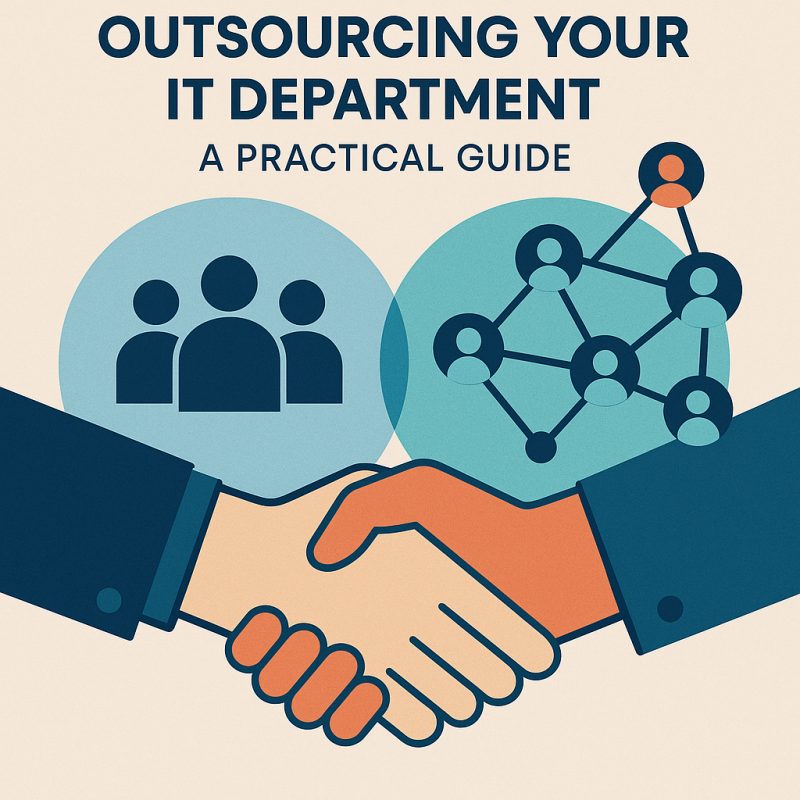
Outsourcing your IT department — a practical guide
Outsourcing IT can be transformative, or it can be an expensive lesson. The difference is almost entirely in how you structure it.
When outsourcing makes sense
You're scaling faster than you can hire. If you need expertise now and can't find or afford full-time staff, outsourcing provides immediate capability.
You need specialised skills temporarily. For security audits, migrations or one-off integrations, renting deep expertise beats building it.
IT isn't your competitive advantage. If it's necessary but not differentiating, outsourcing frees your attention for what is.
You need 24/7 coverage. Round-the-clock monitoring is expensive to staff internally and comparatively cheap to buy.
When to keep it in-house
IT is your product. If you sell technology, you need internal technical leadership — full stop.
Your requirements are unusual and volatile. In-house teams adapt faster when the spec changes weekly.
IT and business decisions are the same conversation. When those need to happen in real time, proximity matters.
You're deliberately building capability. Outsourcing can slow the growth of the team you're trying to grow.
Structuring the relationship
Define success before you sign
Document what outcomes you expect, how you'll measure them, what "good" looks like, and — just as important — what failure looks like.
Start small, expand gradually
Begin with one well-defined project or function. Establish trust and working processes. Expand scope only after value is demonstrated.
Keep strategic control
You should own architecture decisions, technology choices, security policy and business priorities.
The vendor should own implementation detail, day-to-day operations, technical execution and engineering practice.
That line is the whole game. When it blurs, you get vendor lock-in dressed up as partnership.
Build redundancy
Never depend on a single person or vendor. Document processes, cross-train, retain your own access to every system, and keep a backup plan current.
Common pitfalls
Losing institutional knowledge
When you outsource, knowledge walks out with the vendor. Mitigate with comprehensive documentation, scheduled knowledge transfer, a retained core of in-house capability, and vendor-agnostic processes.
Scope creep
Without clear boundaries, outsourced scope expands quietly. Control it with explicit service definitions, a real change-management process, regular scope reviews and clear escalation paths.
Vendor lock-in
Use standard technologies, own your data and systems outright, keep some internal capability, and have an exit strategy written down before you need it.
Communication gaps
Distance and time zones create friction. Counter it with regular syncs, explicit communication protocols, shared documentation and some genuinely overlapping hours.
Making it work
Choose the right model
- Project-based: discrete initiatives with a clear endpoint
- Retainer: ongoing needs with variable scope
- Dedicated team: long-term work requiring deep integration
- Hybrid: internal core, external capacity
Invest in relationship management
Outsourcing isn't delegation — it needs active management: regular business reviews, clear escalation, collaborative problem-solving, and incentives that actually align.
Measure what matters
Cost versus the internal alternative. Quality and reliability. Speed of delivery. Business outcomes achieved. Not hours billed.
Plan for the ending
Every engagement ends eventually. Plan knowledge transfer, system access, process documentation and handover while the relationship is still good.
The decision framework
Five questions:
- Is this core to our business?
- Do we need this capability long-term?
- Can we find and afford internal talent?
- Is the work well-defined?
- Can we maintain control?
If most answers point toward outsourcing, structure it carefully. If they don't, build internally and be patient about it.
Outsourcing isn't about offloading responsibility — it's about accessing expertise and capacity you can't build fast enough. Done right, it accelerates growth. Done wrong, it manufactures dependency and risk.